
Round Rock Resident Lookup Records
Round Rock sits in Williamson County, so a name search often moves between city and county custodians. The useful first source depends on the question. The appraisal roll can connect an owner to a parcel. The county and state voter route may supply limited registration context. A court index can show that a party name exists, but the maintaining court keeps the official file. This Round Rock resident lookup table separates those jobs so one record is not asked to prove more than it can.
| Record source | What it can confirm | Round Rock route | Access boundary |
|---|---|---|---|
| WCAD appraisal roll | Owner, parcel, situs and mailing context | Williamson Central Appraisal District | Public data, not proof of current occupancy |
| Voter lookup | Limited registration, precinct and public identity context | Williamson County voter route | Protected fields and addresses stay restricted |
| County court index | Party, attorney, case, event and calendar leads | Williamson Odyssey | Official file remains with the court |
| Vital verification | Event and correct certificate custodian | Texas DSHS Vital Statistics | Certificates have eligibility rules |
| Recorded documents | Grantor, grantee and recorded-party trail | County Clerk Kofile portal | Online image span needs live confirmation |
Begin with the record most closely tied to the fact already known. A Round Rock name with a street can be tested in WCAD. A name connected to an estate may belong first in probate. A missing online image is not a dead end: the clerk counter, a focused written request, library material, and the Texas State Library and Archives Commission finding aid are separate paths.
Round Rock Property Clues for a Name
WCAD is the strongest public starting point when the person may be an owner. Its search can use an owner name, address, account, property ID, subdivision, ZIP, legal description, property type, status, and tax year. A result may show the owner name, owner mailing address, situs address, property or account identifiers, legal description, neighborhood, values, and tax year. That gives a Round Rock resident lookup a stable parcel reference rather than a bare name.
Keep the two address fields separate. The situs is the taxable property location. The owner mailing address is where tax correspondence goes, and it may be elsewhere. A homestead exemption can support an owner-occupancy inference, but does not prove who is there now. WCAD also warns that its data can contain inaccuracies or typos, so a Round Rock result should be compared with another official index.
Round Rock Names in Williamson Odyssey
For a court-related Round Rock name, Williamson Odyssey divides its public search into Civil, Family & Probate Case Records and Court Calendar. Case search offers Case, Party, and Attorney modes. Calendar search offers Attorney, Case, Judicial Officer, Party, or Defendant Name. Soundex can help with a spelling variation. A wildcard is also allowed, but it cannot be combined with Soundex. The municipal court is separate for city Class C matters, and district-court papers are obtained from the District Clerk.
The following inventory describes a Round Rock court-index result as a lead, not an identity verdict. A case number opens the case information or register material, and some images require a TIF viewer. A red W marker denotes an active warrant status icon, not a full warrant document. Sealed, expunged, juvenile, and other protected material may not appear.
| Case number link | Opens the case information or register material. |
|---|---|
| Party or attorney search | Locates a name within the available court index. |
| Event or register details | Shows activity recorded in the available case view. |
| Red W marker | Flags an active warrant indicator, not a complete warrant record. |
| Image link | May require a TIF viewer and is not promised for every file. |
The state custody search has an even narrower purpose. The Texas Department of Criminal Justice offender search accepts a name, SID, or current TDCJ number and supports wildcards. It reports custody-specific fields, so it should never be merged with a same-name Round Rock match without other public evidence.
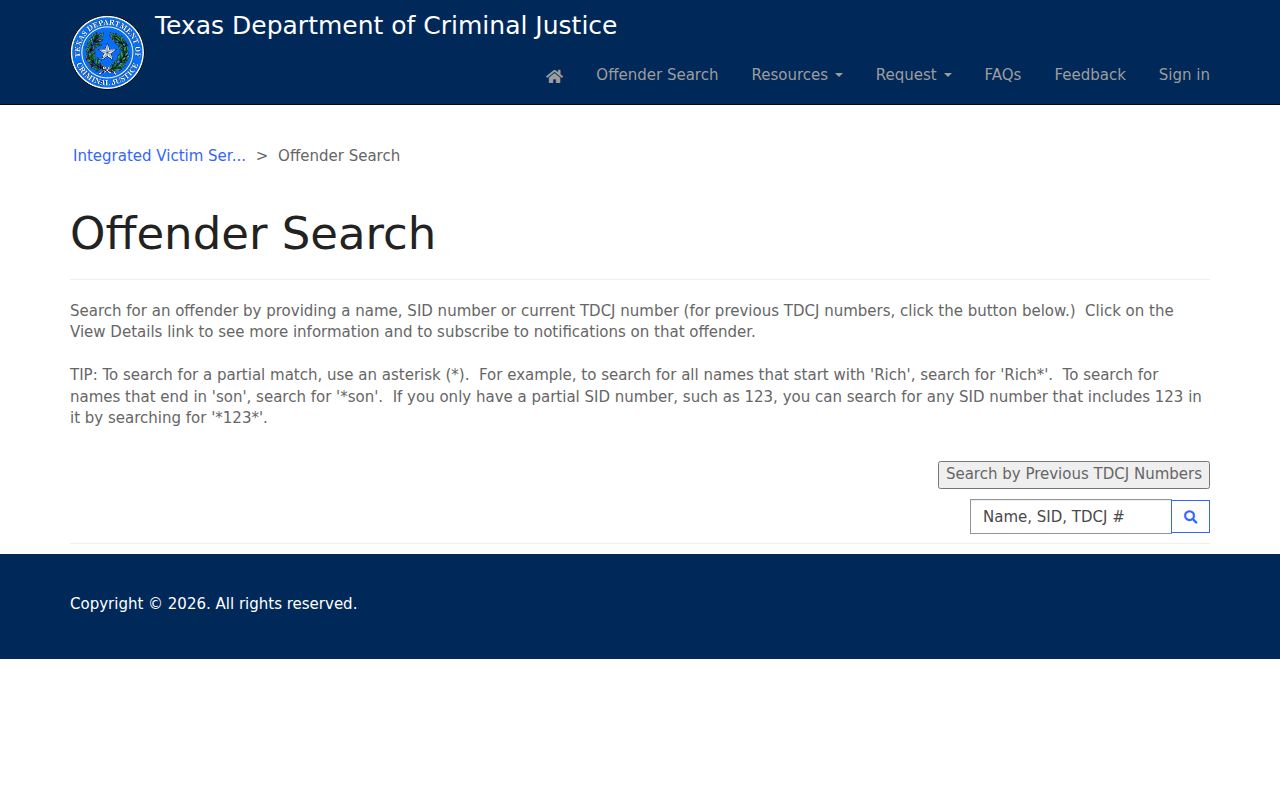
The captured search instructions show why a name, SID, or current-number result must remain tied to the official custody system and its own update process.
Checking a Round Rock Resident Across Records
A sound Round Rock resident lookup anchors a name to a record, then tests it against a second source. Use a middle initial, suffix, spelling variant, date, county, parcel legal description, relative name, and record chronology to sort same-name results. County staff can explain record format, but they do not certify identity over the phone. Keep a note of the source and search date because a portal result can change.
- Search WCAD by owner name or known address, then preserve both the situs and owner mailing fields.
- Check the county or state voter route only for its public registration context, not as identity proof.
- Run Odyssey by Party with controlled name variants, then compare a case date or county with the parcel trail.
- Use a vital verification or the proper clerk only when the event and custodial route fit the question.
Three terms help keep the Round Rock trail clear. A docket is the court's running case record. An index points to a record, while an image is the scanned document when one is available. A certified copy is a copy issued by the office that holds the official record, and it may require a mail or counter transaction.
- Docket
- A court's record of a case, its parties, and the events recorded in it.
- Index versus image
- An index helps locate a record. An image is the actual scanned page when access is available.
- Certified copy
- A copy produced by the custodian with official certification, subject to the custodian's rules.
Round Rock Vital Verification Paths
Vital records have a deliberate custody split. The Williamson County Clerk acts as local registrar for local birth, death, and marriage functions. Texas DSHS Vital Statistics handles statewide birth and death certificates, verification products, and marriage and divorce indexes. A certified marriage license comes from the issuing county clerk, while a certified divorce decree comes from the district clerk that granted it. A verification letter is not the same thing as a certified record.
Texas Government Code §552.115 makes birth records public after 75 years and death records public after 25 years. Before those thresholds, eligibility rules apply. DSHS states that its marriage verification index begins in 1966 and its divorce verification index begins in 1968, but neither index is comprehensive. For a Round Rock family-history question, the county clerk, district clerk, older county material, and local archives may therefore be the better route.
The Texas DSHS vital applications page is the source for the captured forms and order routes.
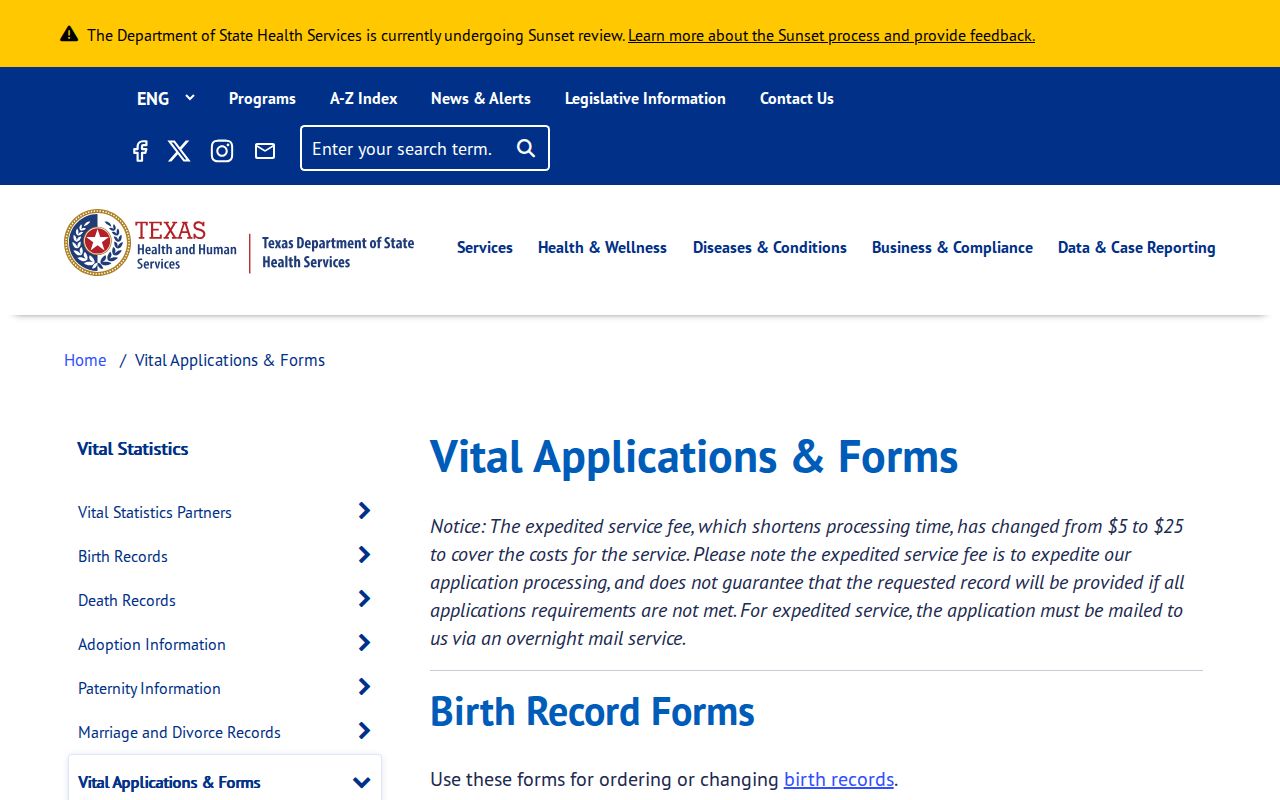
The application landing page is useful for locating the current form, while the custodian and eligibility rule determine whether a copy can be issued.
Round Rock's Same-Name Check
Two Round Rock residents can share a name, and one person can appear under initials, a suffix, a trust, an assumed name, or a spelling variant. Use the parcel's legal description and the sequence of recorded documents to separate a property owner from a similar name in a court index. A spouse or relative name in a probate filing can be a useful historical clue, but a protected attachment must remain protected.
When the question concerns an heir, start with the probate search and request the underlying file from the proper clerk. Williamson County probate material begins in 1848, with later indexes and microfilm described in the state library finding aid. For a former classmate, RRPL and the Williamson County Genealogical Society, Austin-area directory material, and yearbooks can add a time and family context. No complete Round Rock alumni index was located, so a formal school record should not be assumed public.
Round Rock Records Beyond the Search Box
When an online Round Rock result lacks the year, image, or search key, move to the named custodian instead of guessing. The County Clerk cannot perform an open-ended search for the public under AG Opinion WW-607. For recorded documents, use the self-service index, a defined written request, an in-person visit, or a researcher. County recording and vital functions are listed at 1848 Texas Trail in Georgetown, while court functions use the Georgetown Justice Center route.
Texas Public Information Act requests are another limited fallback for records a government body holds. Round Rock asks that city requests be in writing through its Open Records Center, email, or the City Clerk route. Under Chapter 552, a government body generally must release public information unless an exception applies and must notify the requestor if production will take longer than ten business days. Ask for a defined record, date range, and format. Do not treat a request as a way around sealed files, certificate eligibility, or protected addresses.
Round Rock Court Indexes and Official Files
Round Rock court research is split by custodian. Odyssey is the practical Williamson County name index. The District Clerk holds district civil, family, and criminal pleadings and papers. Round Rock Municipal Court maintains city Class C matters, and federal cases follow the Western District of Texas Austin Division and PACER route. This comparison keeps a public index lead separate from the record that can be requested or certified.
| Source | Best use | What it does not settle |
|---|---|---|
| Odyssey | Find a county case, party, attorney, or calendar lead | Whether every document or protected filing is available |
| District Clerk request | Request the actual district-court file or copy | Access to sealed material or an identity conclusion |
| Municipal Court | Check city docket, forms, or citation route | County, district, or federal case coverage |
This difference is a useful Round Rock comparison: a searchable name result is a lead, while the maintaining court controls the official record. The same distinction applies to commercial tools, which can be stale or merge same-name people and should not replace a custodian's record.
Limits on a Round Rock Resident Lookup
Texas public-record access has real boundaries. Voter ID numbers and protected addresses are not ordinary public web content. The Texas Address Confidentiality Program provides a substitute mailing address for qualifying participants, and voter suppression can limit website display without erasing all records subject to the Public Information Act. Appraisal rules also restrict certain residential images, sketches, floor plans, and age-related information. Utility and delivery lists are not public Round Rock resident indexes.
Correct an official record with the office that maintains it. Keep a screenshot, the source URL, and the date of the result. A record can be public without being current, complete, or appropriate to republish. Round Rock records are most useful for personal, lawful research, family history, estate questions, and civic context when each source is used within its own limits.
Lawful use. Use a Round Rock resident lookup for lawful personal research only. Texas Penal Code §§42.07 and 42.072 address harassment and stalking; never use a record to watch, threaten, harass, or intimidate another person.